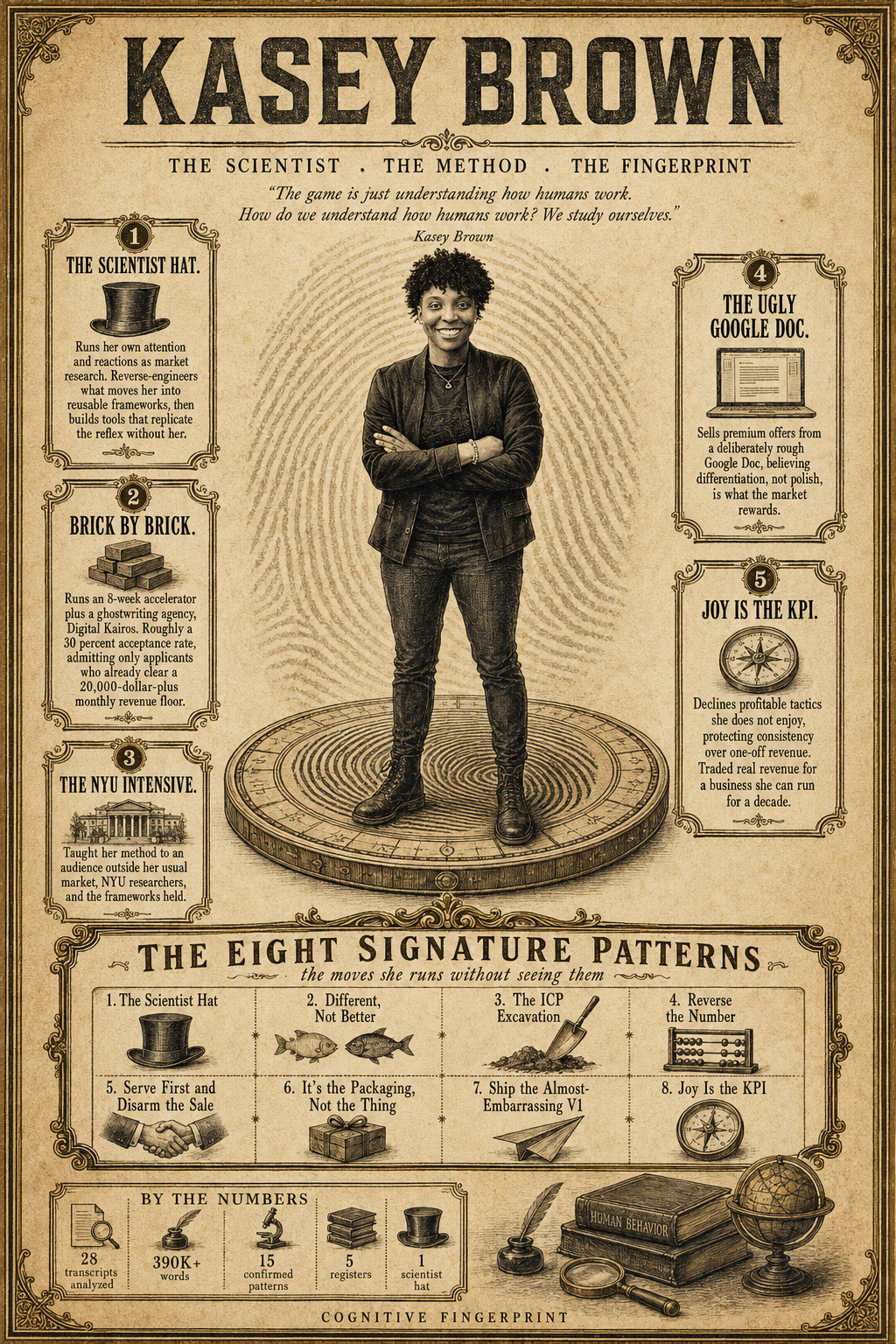
Twenty-eight conversations. Five registers. One reflex running underneath everything you teach.
Your bio says content coach. That is not what is running underneath.
Kasey runs her whole business by running herself as the experiment. Before she is a coach, a marketer, or a brand strategist, she is a scientist whose primary instrument is her own behavior. When something stops her scroll, she asks why. When she buys something, she reverse-engineers what moved her. Everything else in her fingerprint is downstream of this one habit.
We read 28 of her transcripts, roughly 390,000 words, across five registers: a discovery interview, teaching calls, live office hours, workshops, and 1-1 coaching hot seats. The single most valuable pattern we found is The Scientist Hat, DRIVE 24 out of 25. It is the engine that produces the rest.
You treat your own attention, buying, and reactions as your primary market research, and you reverse-engineer them constantly. You believe your own behavior is the most trustworthy data in the market. Not a focus group, not a guru, not best practices. You.
Your load-bearing market law. You believe the market does not reward the highest quality, it rewards the most distinct. Excellence is invisible in a noisy market. Contrast is the only thing the eye catches.
You refuse to let an audience stay general. You dig past the demographic to a specific person and a specific, visceral problem. Specificity is a tax you pay now to earn the privilege of being general later.
When you face a goal, you start from the target and divide backward through every known conversion rate until you reach a concrete daily action. A number is never scary once it becomes a plan.
You lead with the give, you frame every ask in the other person's interest, and you treat the word "sell" as a synonym for "build trust." The entire job is to remove the feeling of being sold.
When something fails to convert, you look at the wrapper, never the contents. The market buys the wrapper and keeps the contents. The packaging earns the chance to deliver the substance.
You release rough on purpose. You believe the market, not your own judgment, is the editor. Perfection is a form of hiding. Speed is a form of respect for the market's judgment over your own.
You optimize for enjoyment as a cold strategic metric, not a soft preference. Joy is not the reward for the work. It is the mechanism that keeps you in the work long enough for the work to pay.
Your blind spots, named.
You repeatedly minimize your own skill. "we are just here to help with the packaging" (NYU Intensive, Jun 8). The packaging is the rare, hard, defensible skill, and you describe it as a clerical add-on.
Your greatest strength, studying yourself, has an edge case: you sometimes design off your own buying psychology before catching that your ICP differs. "Because I was only thinking about myself" (Alumni Workshop, Feb 18).
You cap programs on fit and joy grounds, principled, but you rarely separate "poor fit" from "I haven't built the lower-tier vehicle yet." "we turned down 83 people this time" (Class 4 Kickoff, Apr 22).
Everything we found, on a single map.
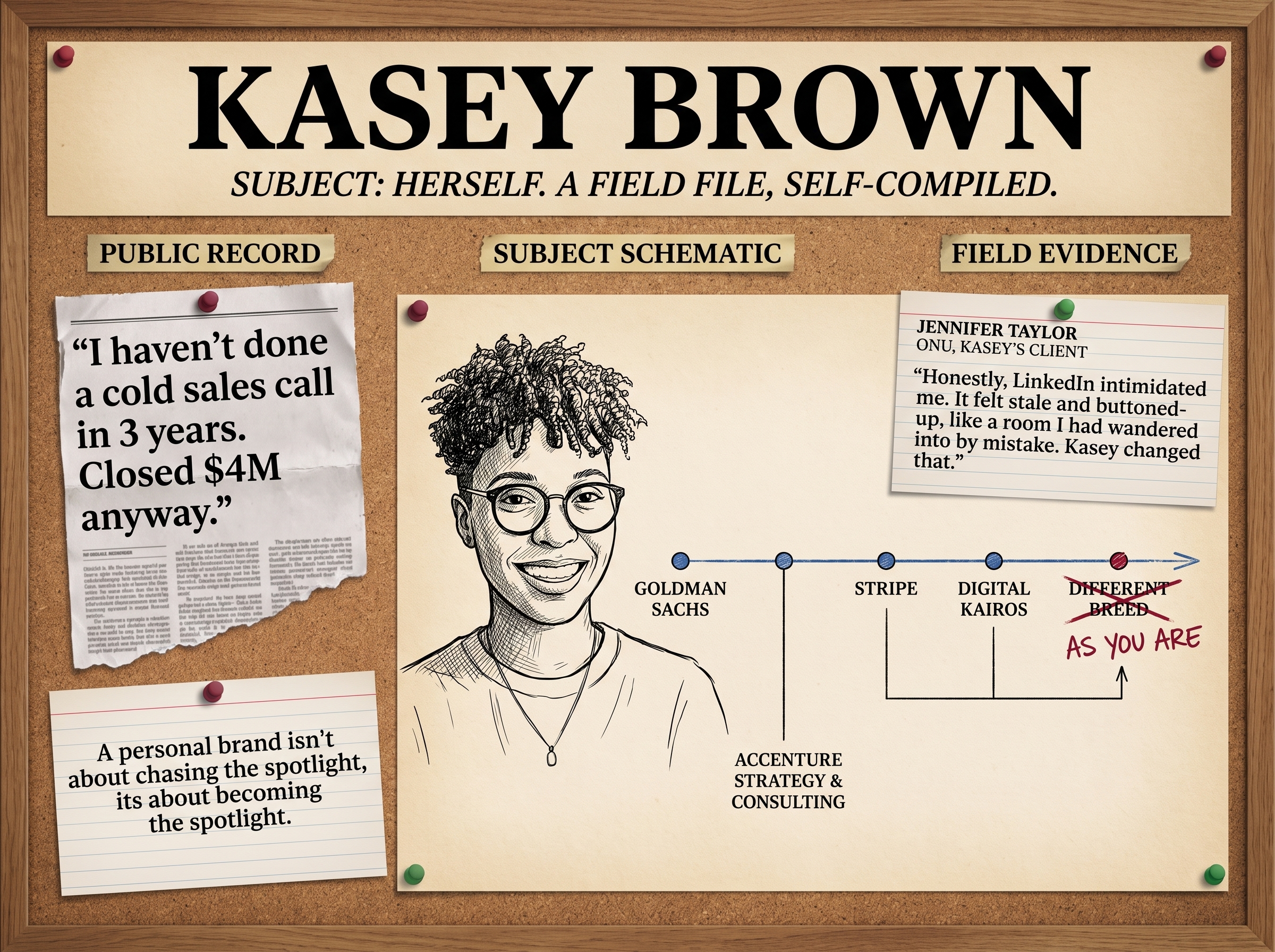
The Scientist Hat, turned on her own LinkedIn.
The same reflex that runs her business runs her feed: reverse-engineer what moves people, then build the thing that repeats it. So we ran the pattern on the one page she didn't build for a client, her own profile, real headline and real career arc included.
The full Cognitive Fingerprint is 28 transcripts, eight signature patterns, three blind spots, each taken to the belief underneath it. There is the full written analysis a click away, and there is a conversation worth having about what this becomes for your next cohort.